Welcome to the Champagne Gardet website
To continue your visit, you must be of legal age to purchase or consume alcohol. If there is no such legislation in your country, you must be at least 18 years old.
I certify that I am of legal ageTo continue your visit, you must be of legal age to purchase or consume alcohol. If there is no such legislation in your country, you must be at least 18 years old.
I certify that I am of legal age
Aware of climate and environmental challenges and as a responsible player, Champagne Gardet has decided to assess its greenhouse gas emissions and commit to a transition process aimed at reducing its ecological footprint, supported by the company Decarbo’Solution®.
«Sustainability guides every step of our activity, from winemaking to business management. At Champagne Gardet, we limit the use of chemicals, prioritize eco-friendly raw materials, and have implemented wastewater treatment. Protecting the environment is at the heart of my profession. These commitments are subject to certifications (involvement in the Haute Valeur Environnementale - HVE - certification for our own vineyard and that of our partner winegrowers, as well as in the traceability and food safety process), which I oversee in my role as Quality Manager at Champagne Gardet.»

Climate change could lead to a temperature increase of up to +5°C by 2100, with impacts that are already visible and growing. In the face of this challenge, Champagne Gardet acknowledges its environmental responsibility and commits to reducing its carbon footprint by assessing its emissions and initiating an ecological transition.
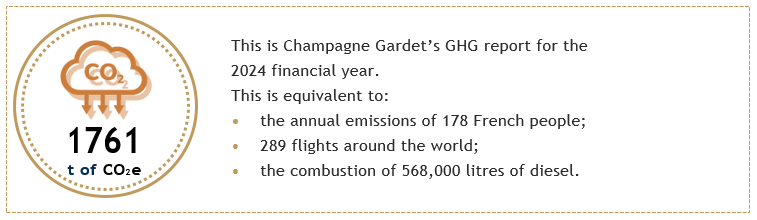
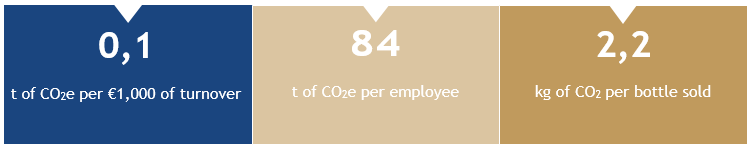
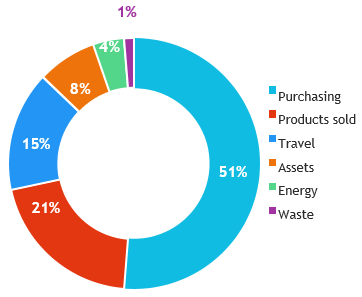
Champagne Gardet’s GHG emissions profifile is typical of a manufacturing company: the main challenge lies in raw materials (51%). The impact associated with products sold is the second largest issue (20%), followed by travel (15%) and assets (8%). The impact of energy consumption remains limited (4%). The uncertainty rate is 19%. Champagne Gardet is committed to a process of continuous improvement, with the first GHG assessment serving to identify the main challenges.
1st Emissions Source: Purchasing (51%)
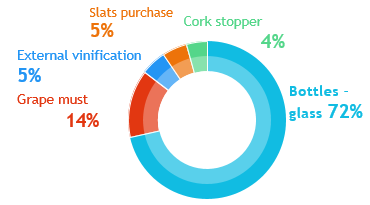
Purchasing accounts for 51% of Champagne Gardet’s footprint. This category is dominated by glass bottles (72%), followed by grape must (14%). Other inputs (external vinifification, slats, cork stoppers) each account for a smaller share (4-5%).
2nd Emissions Source: Products Sold (20%)
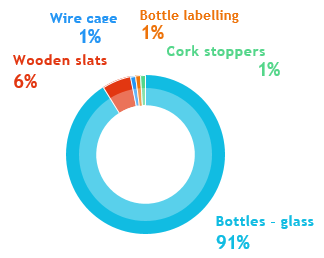
Products sold account for 20% of the footprint and correspond to end-oflife packaging treatment. Glass bottles account for the vast majority of emissions in this category (91%). Other elements (slats/points, wire cages, bottle labeling, cork stoppers) have individual contributions of around 1-6%.
3rd Emissions Source: Travel (15%)
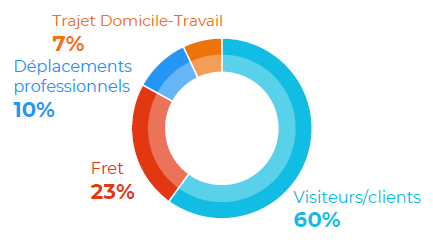
Travel accounts for 15% of the footprint. Human travel constitutes 77% of this category, with a majority share linked to visitors/customers (60%). Freight accounts for 23% of the category’s emissions, primarily represented by upstream freight (21% of travel).
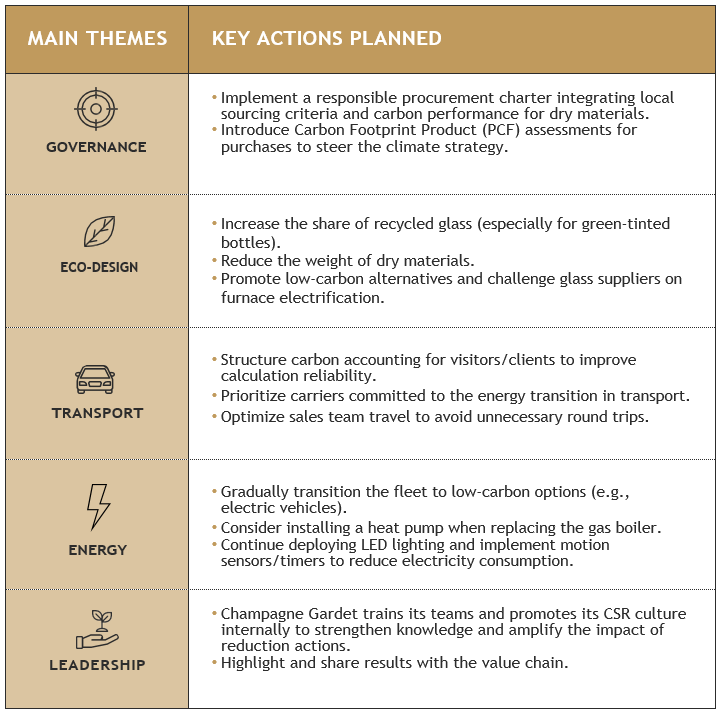
-25%: This is the relative GHG emissions reduction target that Champagne Gardet has set for 2030.